Quiet Tone Official Website › Blog › Quiet Tone Supplement Facts: 5 Steps
Quiet Tone Supplement Facts: 5 Steps to Read the Label
A supplement facts panel is read in five steps: serving size, amounts, percent Daily Value, the salt in brackets, then the blend line. On Quiet Tone, one capsule is a serving, nine rows show amounts, and one blend of 415.5 mg covers 18 names with no split.
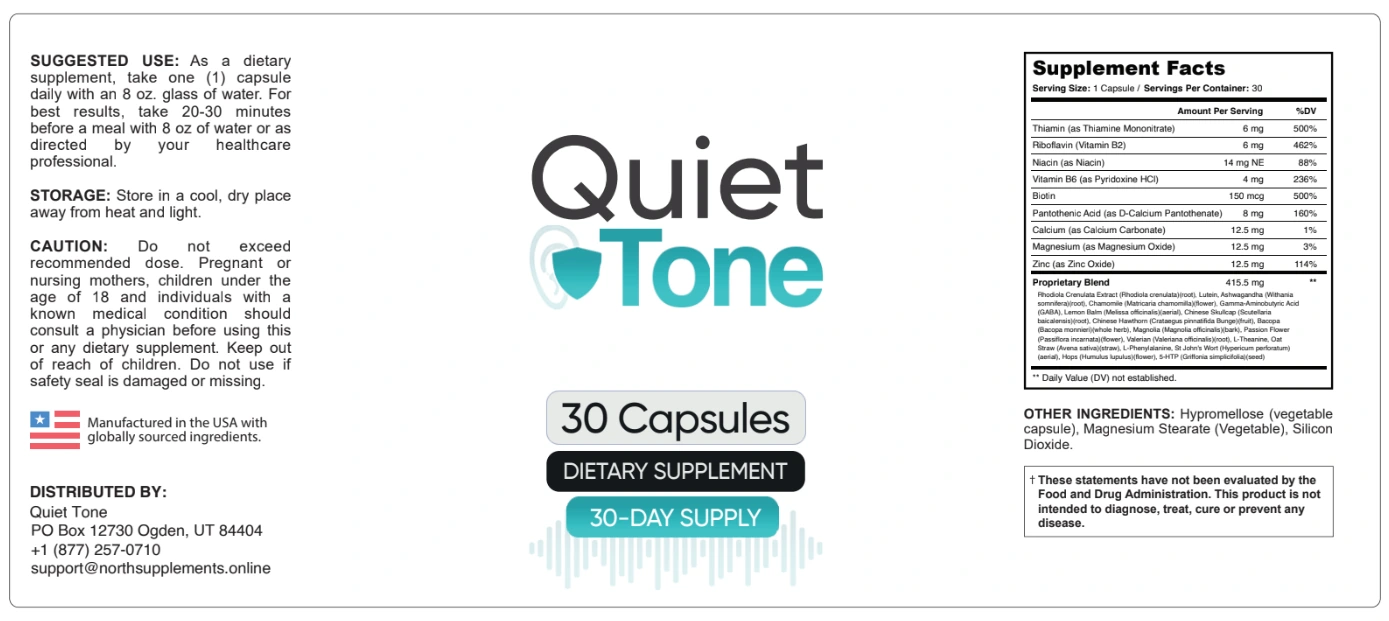
- Serving size is 1 capsule. Servings per container: 30.
- Nine rows carry an amount and a percent Daily Value. The tenth row, the blend, has no Daily Value established.
- Zinc 12.5 mg is 114% of the Daily Value. Calcium 12.5 mg is 1%. Magnesium 12.5 mg is 3%.
- Each mineral names its salt: carbonate, oxide, oxide.
- The proprietary blend is 415.5 mg for 18 names, with no individual amounts.
- Other ingredients: hypromellose (vegetable capsule), magnesium stearate (vegetable), silicon dioxide.
Compare the panel with your bottle
If you decide to order, check the panel on your bottle against this page. The order page lists the packs and the 180-day guarantee.
See today's price and guaranteeDisclosure: this site is a stocking partner that sells Quiet Tone. The button goes to the official order page. Pack prices were last read on September 19, 2026 and can change.
Step 1: Where do you start on a supplement facts panel?
Start at the top, with the serving size and the servings per container. On Quiet Tone the serving is one capsule and the bottle holds 30 servings. Every amount below that line is the amount in one capsule, not in the whole bottle.
This matters because some labels set a serving at more than one capsule. A table that looks generous can shrink once you count the capsules. Here one capsule, once a day, is the whole routine.
Step 2: How do you read the amount and the percent Daily Value?
The first column is the weight. The second is the percent Daily Value, which compares the amount with a reference intake. A line of 100% means a full day's reference amount. Higher is not always better, and 500% of a B vitamin is one of the cheapest numbers to print.
| Row | Amount | % DV | What stands out |
|---|---|---|---|
| Thiamin | 6 mg | 500% | A water-soluble B vitamin |
| Riboflavin | 6 mg | 462% | Turns urine bright yellow, which is harmless |
| Niacin | 14 mg NE | 88% | The only nutrient row below 100% among the B vitamins |
| Vitamin B6 | 4 mg | 236% | Well inside routine intakes |
| Biotin | 150 mcg | 500% | Can distort some lab tests |
| Pantothenic acid | 8 mg | 160% | Printed as the calcium salt |
| Calcium | 12.5 mg | 1% | A tiny contribution to a day's calcium |
| Magnesium | 12.5 mg | 3% | A small contribution, in the oxide form |
| Zinc | 12.5 mg | 114% | The one row with its own tinnitus trial, which found no benefit |
Amounts and percentages are as printed on the label.
If you already take a multivitamin, these nine rows will overlap with it. Doubling up adds cost rather than coverage, and the three minerals compete for the same absorption routes.
Step 3: What does the word in brackets tell you?
Minerals never arrive as the bare element. The word in brackets names the form. Here that is calcium carbonate, magnesium oxide and zinc oxide. The weight printed is the mineral itself, not the weight of the salt, so 12.5 mg of zinc really is 12.5 mg of zinc.
What the salt changes is how much your body takes up. A stable-isotope study put zinc oxide at 49.9% absorbed against 61.3% for zinc citrate. Magnesium oxide is described on this site as the least absorbed of the common magnesium sources. Oxide and carbonate are the budget forms, which is not a fault, but it is a clue about where the formulation budget went.
Step 4: What is different about the blend line?
The tenth row is a proprietary blend of 415.5 mg with two asterisks, which point to the note 'Daily Value (DV) not established'. Under it, 18 names are listed with their Latin names and plant parts. One weight covers all of them.
US rules let a maker print the total of a blend rather than each member, as long as members appear in descending order by weight. That is why rhodiola comes first and 5-HTP last. It tells you the first names are larger than the last ones. It does not tell you by how much, and Quiet Tone does not publish it.
- Chamomile was trialled at 1,500 mg a day in an anxiety study, which is more than three times the whole blend.
- Ashwagandha was used at 600 mg a day in a 1,002-adult safety trial.
- Bacopa's working-memory benefit was placed at 600 mg a day and above.
- L-theanine reviews cover 200 to 400 mg a day, and the GABA capsules in one study held 100 mg.
Those are single-ingredient trial doses. Several of those doses exceed the entire blend by themselves. So if you want a particular plant at its studied dose, a single-ingredient product would give you more of it.
Step 5: What do the lines under the panel add?
Look at the other-ingredients line, the suggested use, the storage line and the caution. They are part of the label too.
- Other ingredients: hypromellose (vegetable capsule), magnesium stearate (vegetable), silicon dioxide. The first is the shell.
- Suggested use: one capsule daily with an 8 oz glass of water, 20-30 minutes before a meal for best results.
- Storage: a cool, dry place away from heat and light.
- Caution: do not exceed the recommended dose. Pregnant or nursing mothers, children under 18 and anyone with a known medical condition should consult a physician. Keep out of reach of children. Do not use if the safety seal is damaged or missing.
- The FDA disclaimer: these statements have not been evaluated by the Food and Drug Administration, and the product is not intended to diagnose, treat, cure or prevent any disease.
Reading a panel is not the same as clearing it for you. If you take any prescription, show the blend list to your prescriber, because St John's wort changes how the body clears many medicines and 5-HTP overlaps with serotonergic antidepressants. The label asks anyone under 18, pregnant, nursing or living with a known condition to see a physician first. No supplement, this one included, is FDA approved.
Is Quiet Tone just a quiet multivitamin?
Some searchers ask whether this is a 'quiet multivitamin'. The top half of the panel looks a little like a small B-complex plus three minerals. A multivitamin usually covers far more nutrients. The bottom half, the 18-name blend, is what sets it apart.
So it is closer to a B-vitamin and mineral base with a plant and amino acid blend on top. That is a description of the panel, not a promise about any effect.
Sources named on this site
- The isotope study of zinc forms
- A review of zinc salt bioavailability
- A comparison of magnesium sources
- The 1,500 mg chamomile trial
- The 600 mg ashwagandha safety trial
- The Bacopa network meta-analysis
- The L-theanine systematic review
- The oral GABA trial
- The review of biotin interference in lab tests
- A 2026 paper on how supplement labels are read
Frequently asked questions
What is the serving size on Quiet Tone?
One capsule is one serving, and there are 30 servings per container. The panel amounts are per capsule.
What does percent Daily Value mean on Quiet Tone?
It compares the amount in a capsule with a reference daily intake. Thiamin at 6 mg is 500%, zinc at 12.5 mg is 114%, and calcium at 12.5 mg is 1%. The blend has no Daily Value established.
Why is there no amount for each herb?
The herbs sit inside a proprietary blend of 415.5 mg. US rules allow the total to be printed with members listed by descending weight. The individual amounts are not published.
What are the other ingredients in Quiet Tone?
Hypromellose (vegetable capsule), magnesium stearate (vegetable) and silicon dioxide.
Does Quiet Tone contain caffeine?
No caffeine is listed on the panel.
Can biotin in Quiet Tone affect a blood test?
Yes. Biotin at 150 mcg is the kind of supplement intake that can distort some lab immunoassays, including troponin and thyroid panels. Tell the person drawing your blood what you take.
Our view
The top half of this panel is honest and easy to check. The bottom half is legal but opaque. A reader can do real arithmetic on the nine printed rows and almost none on the blend.
Our advice is to read the panel the same way you would read any other: serving first, amounts second, brackets third, blend last. If a number cannot be checked, treat the claim attached to it as unproven. That rule works on this bottle and on every other.
A short reminder. The FDA does not approve supplements, so Quiet Tone is not FDA approved. This page is general information, and nothing on it has been evaluated by the Food and Drug Administration. Medical questions belong with your doctor.
Check it against your own bottle
If you order, hold the bottle beside this page. The order page has the packs and the 180-day guarantee, and the bottle is always the final authority.
See today's price and guaranteeDisclosure: Quiettonedaily is the U.S. stocking partner for Quiet Tone and sells it. This button goes to the official order page. Prices were last read on September 19, 2026, so confirm them at checkout.