Quiet Tone Official Website › Supplement Facts
Supplement FactsQuiet Tone Supplement Facts: Each Row Explained
Each Quiet Tone capsule is one serving, and its panel prints ten rows.
Nine show a weight and percent Daily Value, from thiamin at 500% to calcium at 1%. The tenth is a 415.5 mg proprietary blend of 18 plants and amino acids.
For more, learn about the ingredients.
Transcribed from the label artwork, with the arithmetic and the footnotes set beside it.
What does the Quiet Tone Supplement Facts panel print?
Ten rows, transcribed from the artwork exactly as printed.
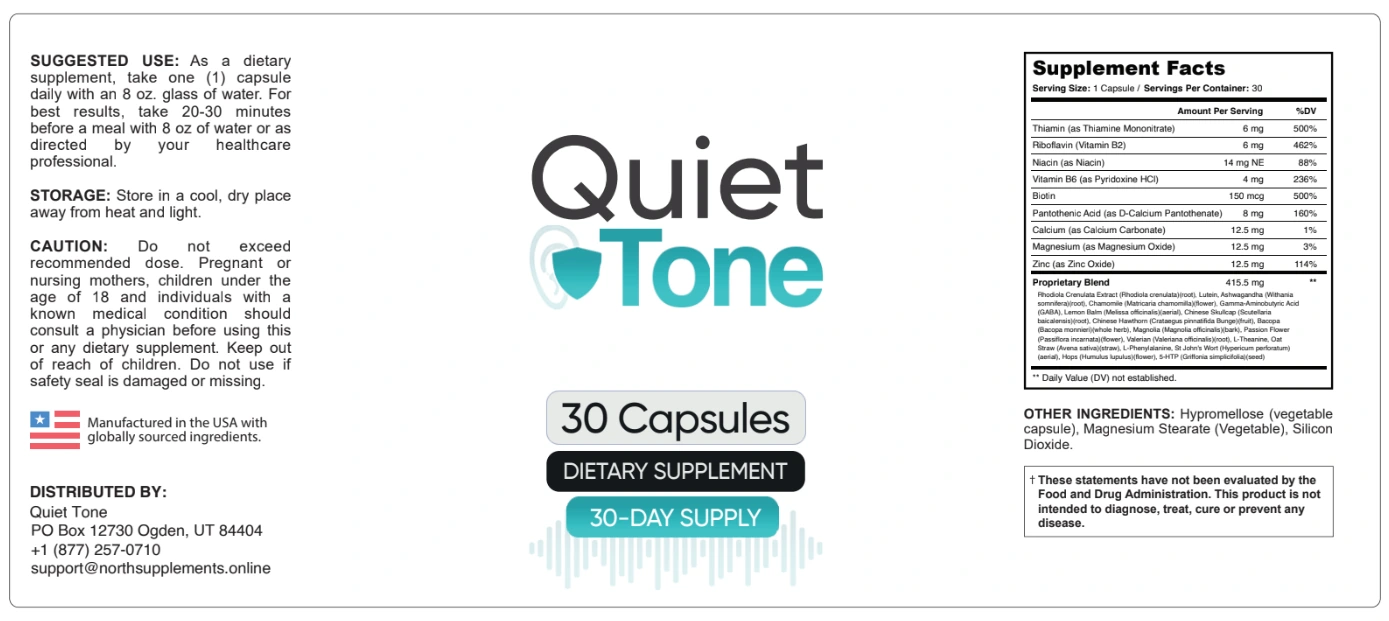
Ten rows, one serving size, one Daily Value column and one dagger footnote. The transcription below is taken from the artwork rather than from any summary of it, which matters because the sales page shortlists and the artwork does not.
Serving size is one capsule. Servings per container is 30. Everything in the table is per capsule, so there is no multiplication to do before comparing a row against a reference intake.
| Row, as the label prints it | Amount per serving | % Daily Value |
|---|---|---|
| Thiamin (as Thiamine Mononitrate) | 6 mg | 500% |
| Riboflavin (Vitamin B2) | 6 mg | 462% |
| Niacin (as Niacin) | 14 mg NE | 88% |
| Vitamin B6 (as Pyridoxine HCl) | 4 mg | 236% |
| Biotin | 150 mcg | 500% |
| Pantothenic Acid (as D-Calcium Pantothenate) | 8 mg | 160% |
| Calcium (as Calcium Carbonate) | 12.5 mg | 1% |
| Magnesium (as Magnesium Oxide) | 12.5 mg | 3% |
| Zinc (as Zinc Oxide) | 12.5 mg | 114% |
| Proprietary Blend | 415.5 mg | ‡ |
‡ Daily Value not established. That footnote applies to the Proprietary Blend row and is the label’s own mark.
Nine of the ten rows resolve to a weight you can check. The tenth resolves to a weight covering 18 names, and the next section opens it out.
What is inside the Quiet Tone proprietary blend row?
One row, eighteen names, and the two columns most summaries drop.
Eighteen names, printed underneath the 415.5 mg figure with a binomial and a plant part against most of them. The order is the label’s own, and under US labelling rules a blend’s members appear in descending order of weight, so the sequence carries information even though the individual figures do not.
| In the blend, as the label prints it | Binomial | Part used |
|---|---|---|
| Rhodiola Crenulata Extract | Rhodiola crenulata | root |
| Lutein | — | — |
| Ashwagandha | Withania somnifera | root |
| Chamomile | Matricaria chamomilla | flower |
| Gamma-Aminobutyric Acid (GABA) | — | — |
| Lemon Balm | Melissa officinalis | aerial |
| Chinese Skullcap | Scutellaria baicalensis | root |
| Chinese Hawthorn | Crataegus pinnatifida Bunge | fruit |
| Bacopa | Bacopa monnieri | whole herb |
| Magnolia | Magnolia officinalis | bark |
| Passion Flower | Passiflora incarnata | flower |
| Valerian | Valeriana officinalis | root |
| L-Theanine | — | — |
| Oat Straw | Avena sativa | straw |
| L-Phenylalanine | — | — |
| St John’s Wort | Hypericum perforatum | aerial |
| Hops | Humulus lupulus | flower |
| 5-HTP | Griffonia simplicifolia | seed |
Reproduced in the label’s printed order. The binomial and plant part columns are the artwork’s own specification, which most summaries of this product drop.
The plant-part column is the detail worth lingering on. Valerian is specified as root, which is the part the 60-study meta-analysis worked with. Oat is specified as straw rather than grain, which is the form used in the acute cognition trial. Passion flower and St John’s wort are specified as aerial parts. Getting the part right is not a small thing: much of the variability between botanical products comes from a supplier using a cheaper part of the same plant.
What the column cannot tell you is how the 415.5 mg is divided. Rhodiola is printed first and 5-HTP last, so the members at the end of the row weigh less than those at the start, and no further arithmetic is available. The ingredients page sets the blend total against the single-ingredient trial doses, which is the comparison the label does support.
How should the Quiet Tone percent Daily Values be read?
What a percent Daily Value measures, and the pattern down this particular column.
A percent Daily Value compares a row against a reference intake for an adult on a 2,000 calorie diet. It is a nutritional yardstick. It is not a measure of potency, and on this panel the difference between those two things is the single most useful thing to understand.
| Row | % DV | What that percentage is measuring |
|---|---|---|
| Thiamin 6 mg | 500% | Five times a day’s reference intake of a vitamin most diets already supply. Cheap to put in a capsule. |
| Biotin 150 mcg | 500% | Five times the reference. The consequence here is a laboratory one rather than a nutritional one. |
| Riboflavin 6 mg | 462% | Four and a half times the reference, and the reason urine turns bright yellow. |
| Vitamin B6 4 mg | 236% | A routine supplement amount, far below the range where the safety literature sits. |
| Zinc 12.5 mg | 114% | Just over a day’s reference, in the oxide salt. |
| Pantothenic acid 8 mg | 160% | Comfortably above the reference; deficiency is rare in the first place. |
| Niacin 14 mg NE | 88% | Just under a day’s reference. |
| Magnesium 12.5 mg | 3% | Three per cent of a day, in the least absorbable common salt. |
| Calcium 12.5 mg | 1% | One per cent of a day. A tablet-forming mineral at this amount. |
The two largest percentages on the panel belong to the two cheapest rows, and the two smallest belong to the two minerals.
Read that column top to bottom and a pattern appears that is worth naming: the percentages are highest where the ingredient costs least. That is not dishonest and it is extremely common, but it does mean a panel can look generous while the expensive rows sit unquantified inside a blend.
The minerals are the other half of the picture. Zinc at 114% is the only mineral row that reaches a day’s reference, and it does so in the oxide salt: a stable-isotope study put zinc oxide at 49.9% absorbed against 61.3% for citrate, and a review of zinc forms sets out the wider comparison. A 2024 comparison of magnesium sources places oxide at the bottom of its list too.
What else does the Quiet Tone label print?
Four printed blocks, quoted rather than paraphrased.
Below the panel the artwork carries four further blocks, and all four are quoted here in full because they are the manufacturer’s own words rather than a summary of them.
Other Ingredients
Hypromellose (vegetable capsule), Magnesium Stearate (Vegetable), Silicon Dioxide. The first of those is the capsule shell and is why this is a vegetable capsule rather than a gelatin one.
Suggested Use
As a dietary supplement, take one (1) capsule daily with an 8 oz. glass of water. For best results, take 20-30 minutes before a meal with 8 oz of water or as directed by your healthcare professional.
Storage
Store in a cool, dry place away from heat and light. A closed cupboard, away from the hob and the window.
Distributed by
Quiet Tone, PO Box 12730, Ogden, UT 84404. That address differs from the returns address in the distributor’s own paperwork, and the refund page explains which one a parcel should actually go to.
Do not exceed recommended dose. Pregnant or nursing mothers, children under the age of 18 and individuals with a known medical condition should consult a physician before using this or any dietary supplement. Keep out of reach of children. Do not use if safety seal is damaged or missing.
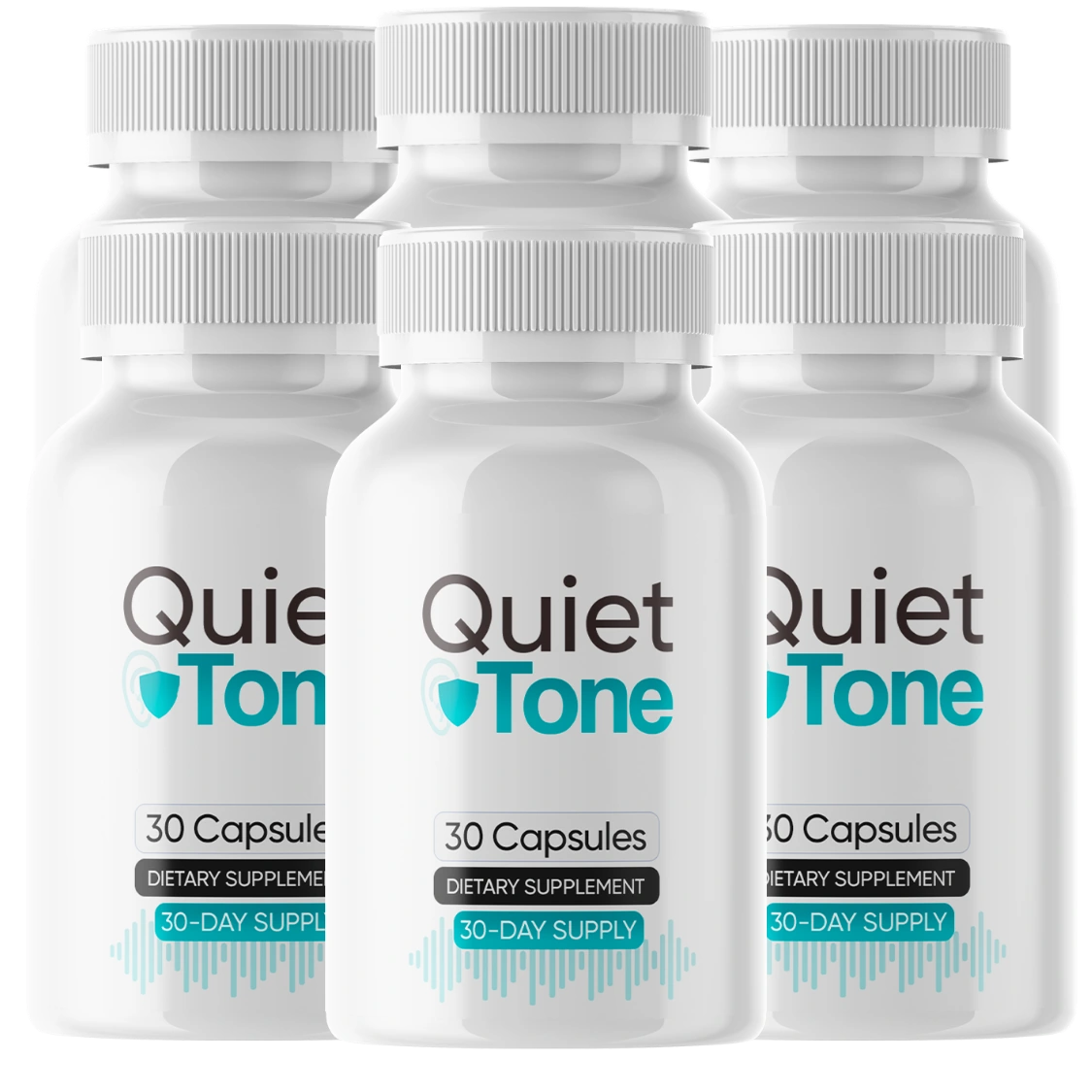
The front of the bottle prints five lines and no benefit claim: Quiet Tone, 30 Capsules, Dietary Supplement, 30-Day Supply, and a manufacturing origin statement. The claims page audits each of those five.
What does one Quiet Tone bottle actually contain?
Four numbers that follow directly from the serving size.
Panel arithmetic, done once, so that nothing further down this site has to repeat it.
That last figure is the only bottle-level number worth carrying: a full bottle delivers around twelve and a half grams of blend across thirty days, shared between 18 members. It is the same comparison the ingredients page makes at the daily level, restated at the scale a buyer actually purchases.
The nine nutrient rows scale the same way and stay checkable at every scale: 6 mg of thiamin a day is 180 mg across a bottle, 12.5 mg of zinc a day is 375 mg. None of those totals approaches a tolerable upper intake for the nutrient concerned.
Quiet Tone panel questions
What is the Quiet Tone serving size?
One capsule. The panel states 30 servings per container, so every figure in the table is a per-capsule amount and a bottle covers 30 days at label dose.
Why does one Quiet Tone row have a dagger instead of a percentage?
Because no Daily Value has been established for a proprietary blend. The dagger footnote is the label’s own mark and it applies to the 415.5 mg row, which has no reference intake to be measured against.
Does the Quiet Tone panel list allergens?
No allergen statement appears on the artwork. The Other Ingredients line names hypromellose, magnesium stearate and silicon dioxide, none of which is a major allergen, but the absence of a statement is not the same as a certified absence of allergens.
Is the Quiet Tone panel the same on every bottle?
The panel transcribed here is from the artwork supplied with lot QUI-26/QU-5380. Formulas and artwork can be revised between production runs, so the bottle in your hand is the authority. The batch page explains how to check the stamp.
How much of each herb is in the Quiet Tone blend?
The label does not divide the 415.5 mg, and this desk will not estimate it. What the label does give is the printed order, which is descending by weight, so rhodiola weighs more than 5-HTP and no further arithmetic follows from that.
Sources for the Quiet Tone panel analysis
The absorption and form studies behind the Daily Value section, in the order the rows appear.
- Wegmüller R, Tay F, Zeder C, Brnic M, Hurrell RF. Zinc absorption by young adults from supplemental zinc citrate is comparable with that from zinc gluconate and higher than from zinc oxide. J Nutr. 2014;144(2):132-6. Zinc oxide 49.9% absorbed versus 61.3% for citrate at a 10 mg dose; three of fifteen adults absorbed little or none from the oxide. PMID 24259556. https://pubmed.ncbi.nlm.nih.gov/24259556/
- Devarshi PP, Mao Q, Grant RW, Hazels Mitmesser S. Comparative absorption and bioavailability of various chemical forms of zinc in humans: a narrative review. Nutrients. 2024;16(24):4269. PMID 39770891. https://pubmed.ncbi.nlm.nih.gov/39770891/
- Pajuelo D, Meissner JM, Negra T, Sanz-Serrano J, Elcoroaristizabal X. Comparative clinical study on magnesium absorption and side effects after oral intake of microencapsulated magnesium versus other magnesium sources. Nutrients. 2024;16(24):4367. PMID 39770988. https://pubmed.ncbi.nlm.nih.gov/39770988/
- Shinjyo N, Waddell G, Green J. Valerian root in treating sleep problems and associated disorders — a systematic review and meta-analysis. J Evid Based Integr Med. 2020;25:2515690X20967323. Sixty studies, 6,894 participants. PMID 33086877. https://pubmed.ncbi.nlm.nih.gov/33086877/
- Kennedy DO, Jackson PA, Forster J, et al. Acute effects of a wild green-oat (Avena sativa) extract on cognitive function in middle-aged adults: a double-blind, placebo-controlled, within-subjects trial. Nutr Neurosci. 2017;20(2):135-151. Single doses of 800 mg and 1,600 mg; the effect sat at or below 800 mg. PMID 26618715. https://pubmed.ncbi.nlm.nih.gov/26618715/
- Schoenen J, Jacquy J, Lenaerts M. Effectiveness of high-dose riboflavin in migraine prophylaxis. A randomized controlled trial. Neurology. 1998;50(2):466-70. The trial dose was 400 mg a day. PMID 9484373. https://pubmed.ncbi.nlm.nih.gov/9484373/
- Dasgupta A. Immunoassay design and biotin interference. Adv Clin Chem. 2022;109:165-183. PMID 35953126. https://pubmed.ncbi.nlm.nih.gov/35953126/
- Katan MB. [How much vitamin B6 is toxic?] Ned Tijdschr Geneeskd. 2005;149(46):2545-6. PMID 16320662. https://pubmed.ncbi.nlm.nih.gov/16320662/
- Alsawadi A. The perception filler: a proposed conceptual framework for ingredient-interpretation gaps in food supplements. J Nutr. 2026;156(10):101803. PMID 42660500. https://pubmed.ncbi.nlm.nih.gov/42660500/
Order Quiet Tone with the panel in front of you
Ten rows, 9 of them checkable against any reference table, one capsule a day and 180 days from purchase to change your mind.
Two bottles $158 · six bottles $294 · 180-day money-back guarantee
Order Quiet Tone On The Official WebsiteOne capsule a day · 30 per bottle · lot QUI-26/QU-5380