Quiet Tone Official Website › How It Works
How It WorksHow Does Quiet Tone Work? A Capsule With Three Routes
Each Quiet Tone capsule opens in the stomach within minutes, and its 24 actives take three routes.
Six B vitamins and three minerals act as enzyme co-factors. Four amino acids and seven calming botanicals work on arousal and sleep chemistry, and three adaptogens work through the stress axis.
Next, see how to take it.
The journey of one capsule, the three mechanisms behind it, and the guidelines that set the context.
What happens after you swallow a Quiet Tone capsule?
One shell, three quite different absorption stories.
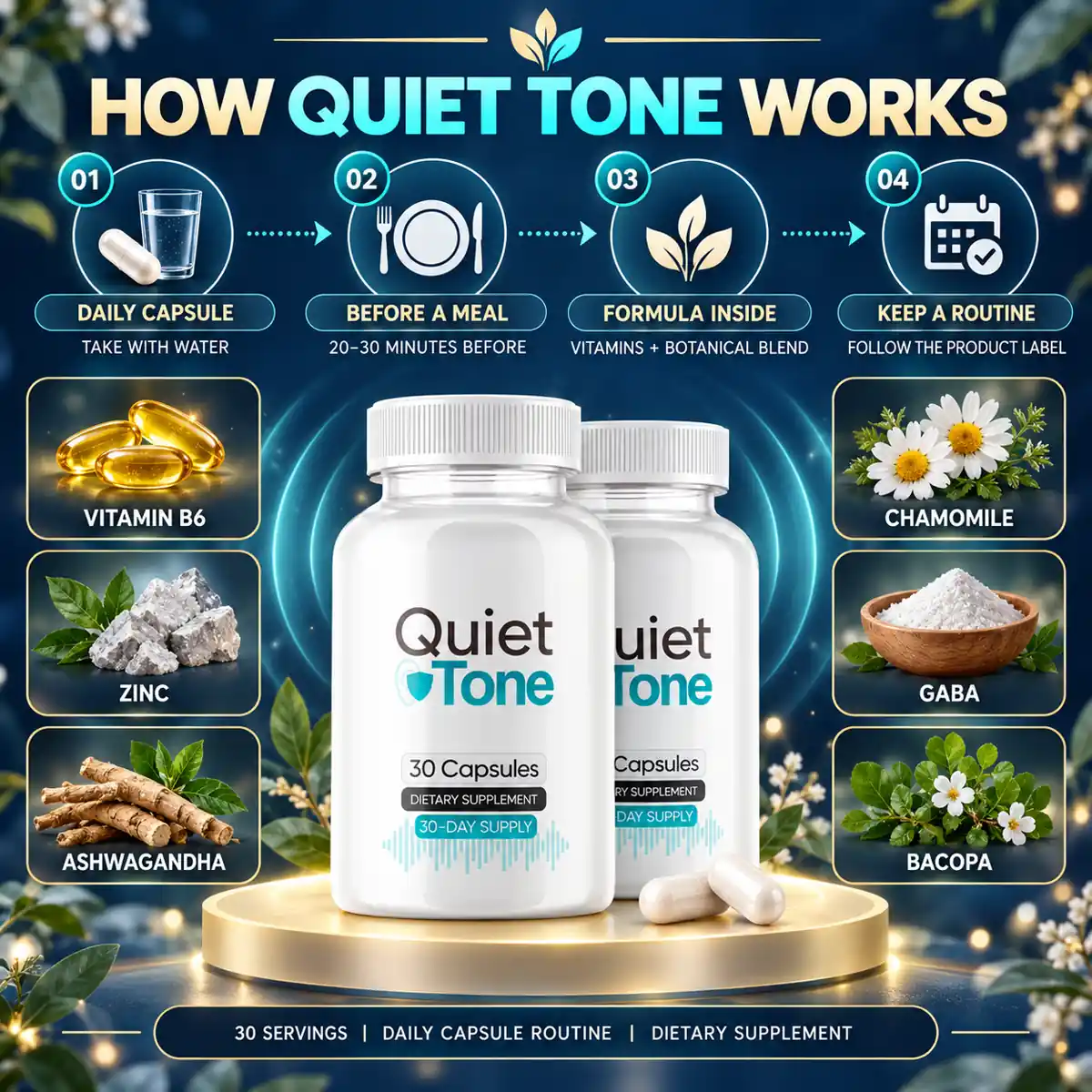
The hypromellose shell softens and opens in the stomach within minutes, and the powder disperses into whatever is there. The label asks for eight ounces of water and a twenty to thirty minute gap before a meal, which is a request about an empty-ish stomach rather than a full one.
From that point the twenty-four active names split into three quite different journeys. The B vitamins are water-soluble and follow the route every water-soluble vitamin follows: absorbed in the small intestine, circulated, and the surplus passed in urine within hours. The three minerals compete for the same transporters as the minerals in your last meal. The eighteen botanicals and amino acids do eighteen different things, and only some of them are mapped.
That is the honest architecture of any multi-ingredient capsule, and it is why the question “how does it work” has a general answer and a specific one. The general answer is above. The specific answer — what each route is expected to achieve — is where this page has to be careful, because the bottle itself claims nothing at all.
Which three routes does the Quiet Tone formula use?
Twenty-four actives, three mechanisms, three different amounts of evidence.
Sorting twenty-four actives by mechanism rather than by name gives three routes. Each one has a different weight of evidence behind it, and saying which is which is more useful than a diagram.
Route one, nutrient status
Thiamin, riboflavin, niacin, B6, biotin and pantothenic acid, plus calcium, magnesium and zinc. These are co-factors: they let enzymes do work the body was already trying to do. Where someone is short of one, topping it up changes something measurable. Where they are not, it does not, and the surplus water-soluble vitamin leaves in the urine. This route is well understood and its limits are equally well understood.
Route two, the GABAergic and serotonergic rows
GABA, L-theanine, 5-HTP, L-phenylalanine and the seven sedative botanicals act, or are proposed to act, on the signalling chemistry involved in arousal and sleep. The L-theanine review and the GABA work both describe effects at amounts well above what one blend row can hold, and oral GABA has a long-standing question mark over how much of it crosses into the brain at all. The mechanism is plausible; the amounts here are the constraint.
Route three, the adaptogens
Ashwagandha, rhodiola and bacopa, whose proposed mechanism runs through the stress axis rather than through a single receptor. The adaptogen literature is the most contested of the three routes methodologically, and also the one with the largest single trials behind it, including 1,002 adults on 600 mg of ashwagandha a day.
Notice what is not among the three. There is no route here that acts on the cochlea, the auditory nerve or the central auditory pathway, because no ingredient on this panel has been shown to act on any of them. That is not a criticism of the formula so much as a description of the category.
What does the research say about Quiet Tone-type formulas and the ear?
Two clinical practice guidelines, two Cochrane reviews and an umbrella review, summarised without spin.
This is the section where the evidence has to be laid out straight, and the fairest way to do it is to go to the guidelines rather than to any single study.
The 2014 AAO-HNS clinical practice guideline on tinnitus is the standing professional document in the United States. On supplements it is unambiguous: it recommends against ginkgo biloba, melatonin, zinc and other dietary supplements for treating persistent, bothersome tinnitus. The executive summary puts the same conclusion in a single page, and the 2026 Korean clinical practice guideline reaches a comparable position on a separate evidence review.
| Evidence source | What it looked at | What it concluded |
|---|---|---|
| Cochrane, zinc | 3 trials, 209 adults | No evidence of benefit; all outcomes very low certainty |
| Cochrane, ginkgo | 12 trials, 1,915 participants | Little to no effect on tinnitus handicap |
| 2026 systematic review, OTC products | Over-the-counter tinnitus products | No consistent symptom relief across the products reviewed |
| 2026 umbrella review | Systematic reviews with meta-analysis | Maps where the effective interventions actually are |
| Network meta-analysis, drugs | Pharmacological interventions | Sets the ceiling the prescription options themselves reach |
Every row is a live PubMed record. None of these studies tested this product.
The interventions with the best evidence in that literature are not capsules. They are sound-based management, cognitive behavioural approaches and, where a hearing loss is present, correcting the hearing loss. MedlinePlus keeps a plain-English version of the same picture. A formula built around calm and sleep can sit alongside those; there is a reason so many people in this category report that the ringing is worse when they are exhausted.
None of which makes a calm-and-sleep stack a poor purchase. It makes it a calm-and-sleep stack, bought with an honest picture of what the category can and cannot show, which is exactly the picture this page is for.
How long does the Quiet Tone routine take to settle?
Three ingredient groups, three different clocks.
Different rows have different clocks, and conflating them is how expectations go wrong. Water-soluble vitamins reach steady tissue levels in days. Mineral stores move over weeks. The botanical rows in the sedative group are the slowest of all: the chamomile and ashwagandha trials ran for eight weeks or longer before reading their endpoints.
The distributor’s summary of 1,189 written reviews puts the most common wait at 4–8 weeks, which is consistent with the trial lengths rather than with the arrival of the parcel. Two of the three bottles in the three-pack are gone by the end of that window, which is one practical reason the ladder starts where it does. The results timeline page sets week against week in detail.
Where does the Quiet Tone mechanism stop?
Two columns, and the second one is why this page is worth reading.
A mechanism page that only explains is half a page. Three limits belong here, stated once each.
What the mechanism genuinely supports
- Nine rows are checkable against any reference table you like
- The sedative and adaptogen groups have real, published human trials behind them
- The shell, the flow agents and the plant parts are all specified on the artwork
- One capsule a day is the simplest routine in the category and the easiest to keep
What it cannot reach
- One 415.5 mg figure covers 18 members, so no member can be checked
- The minerals use oxide and carbonate salts, which absorb least well of the common forms
- Nothing on the panel acts on the cochlea or the auditory nerve
- The trial doses behind the best-studied plants are larger than the whole blend
Read together those two columns describe a competent general calm-and-sleep capsule with a transparent vitamin half and an opaque botanical half. That is a defensible thing to buy at forty-nine to seventy-nine dollars a bottle. It is not a treatment, and the bottle does not say it is.
How Quiet Tone works: common questions
How does Quiet Tone work in simple terms?
One capsule delivers 9 vitamins and minerals at nutritional amounts plus a 415.5 mg blend of 18 plants and amino acids, most of which are studied in stress, sleep and relaxation. The vitamins act as enzyme co-factors; the botanicals act, where they act, on arousal and sleep chemistry.
Does Quiet Tone act on the ear itself?
No ingredient on this panel has been shown to act on the cochlea or the auditory nerve. The AAO-HNS guideline recommends against dietary supplements for persistent, bothersome tinnitus, and the one ingredient here with a trial of its own, zinc, did not show benefit.
Why is Quiet Tone taken before a meal?
The label asks for twenty to thirty minutes before eating, with eight ounces of water. A relatively empty stomach reduces competition for the mineral transporters and speeds the shell opening. It is the manufacturer’s instruction and following it costs nothing.
Does oral GABA in Quiet Tone reach the brain?
That is a genuinely open question in the literature and it is worth knowing before buying. The study using 100 mg capsules measured mood under stress rather than brain concentrations. How much oral GABA crosses the blood-brain barrier in humans remains debated.
Will Quiet Tone make me drowsy during the day?
The blend leans sedative, with seven traditional calming botanicals plus GABA, L-theanine and 5-HTP. The label sets no time of day. Anyone who finds the capsule settling can move it to the evening, since nothing on the panel requires a morning dose.
Sources for how Quiet Tone is said to work
The guidelines first, then the reviews, then the trials behind each of the three routes.
- Tunkel DE, Bauer CA, Sun GH, et al. Clinical practice guideline: tinnitus. Otolaryngol Head Neck Surg. 2014;151(2 Suppl):S1-S40. PMID 25273878. https://pubmed.ncbi.nlm.nih.gov/25273878/
- Tunkel DE, Bauer CA, Sun GH, et al. Clinical practice guideline: tinnitus executive summary. Otolaryngol Head Neck Surg. 2014;151(4):533-41. PMID 25274374. https://pubmed.ncbi.nlm.nih.gov/25274374/
- Park E, Lee HY, Kim HJ, et al. Clinical practice guideline for the diagnosis and management of tinnitus in Korea. Clin Exp Otorhinolaryngol. 2026; published online 6 July 2026. PMID 42409067. https://pubmed.ncbi.nlm.nih.gov/42409067/
- Person OC, Puga ME, da Silva EM, Torloni MR. Zinc supplementation for tinnitus. Cochrane Database Syst Rev. 2016;11(11):CD009832. Three trials, 209 adults; no evidence of benefit, all outcomes very low-certainty. PMID 27879981. https://pubmed.ncbi.nlm.nih.gov/27879981/
- Sereda M, Xia J, Scutt P, Hilton MP, El Refaie A, Hoare DJ. Ginkgo biloba for tinnitus. Cochrane Database Syst Rev. 2022;11(11):CD013514. Twelve trials, 1,915 participants; little to no effect on tinnitus handicap, very low certainty. PMID 36383762. https://pubmed.ncbi.nlm.nih.gov/36383762/
- Menon R, Ziner J, Tolordava A, et al. Effectiveness of over-the-counter treatments for tinnitus symptom relief: a systematic review. Laryngoscope Investig Otolaryngol. 2026;11(2):e70398. PMID 41948711. https://pubmed.ncbi.nlm.nih.gov/41948711/
- Chen K, Monaghan NP, Nguyen SA, et al. Outcomes of tinnitus interventions: an umbrella review of systematic reviews with meta-analysis. Ann Otol Rhinol Laryngol. 2026;135(5):342-355. PMID 41461570. https://pubmed.ncbi.nlm.nih.gov/41461570/
- Chen JJ, Chen YW, Zeng BY, et al. Efficacy of pharmacologic treatment in tinnitus patients without specific or treatable origin: a network meta-analysis of randomised controlled trials. EClinicalMedicine. 2021;39:101080. PMID 34611615. https://pubmed.ncbi.nlm.nih.gov/34611615/
- MedlinePlus Medical Encyclopedia. Tinnitus. U.S. National Library of Medicine. Read 19 September 2026. https://medlineplus.gov/ency/article/003043.htm
- Williams JL, Everett JM, D'Cunha NM, et al. The effects of green tea amino acid L-theanine consumption on the ability to manage stress and anxiety levels: a systematic review. Plant Foods Hum Nutr. 2020;75(1):12-23. The reviewed trials used 200-400 mg a day. PMID 31758301. https://pubmed.ncbi.nlm.nih.gov/31758301/
- Yoto A, Murao S, Motoki M, et al. Oral intake of γ-aminobutyric acid affects mood and activities of central nervous system during stressed condition induced by mental tasks. Amino Acids. 2012;43(3):1331-7. The capsules held 100 mg of GABA. PMID 22203366. https://pubmed.ncbi.nlm.nih.gov/22203366/
- Łuszczak J, Kocki J. Clinical evidence for the adaptogenic effects of Withania somnifera and Rhodiola rosea — a systematic review with molecular interpretation of psychometric outcomes. Ann Agric Environ Med. 2026;33(1):3-11. PMID 41906501. https://pubmed.ncbi.nlm.nih.gov/41906501/
- Pakhale K, Salve J, Ademola J, et al. Safety of 8-week administration with ashwagandha (Withania somnifera) root extract in adults with stress and anxiety. Phytother Res. 2026;40(8):5005-5015. The trial dose was 600 mg a day in two divided doses, in 1,002 adults. PMID 41943502. https://pubmed.ncbi.nlm.nih.gov/41943502/
- Mao JJ, Xie SX, Keefe JR, Soeller I, Li QS, Amsterdam JD. Long-term chamomile (Matricaria chamomilla L.) treatment for generalized anxiety disorder: a randomized clinical trial. Phytomedicine. 2016;23(14):1735-1742. The trial dose was 1,500 mg a day, as 500 mg three times daily. PMID 27912875. https://pubmed.ncbi.nlm.nih.gov/27912875/
- Tiemtad P, Ingkaninan K, Temkitthawon P, et al. Comparative effects of Bacopa monnieri and Ginkgo biloba on cognitive functions: a systematic review and network meta-analysis. Phytomedicine. 2026;153:157915. Twenty-nine trials, 2,107 people; the working-memory benefit belonged to doses of 600 mg a day and above. PMID 41678913. https://pubmed.ncbi.nlm.nih.gov/41678913/
Order Quiet Tone knowing what the mechanism reaches
Three routes, 30 capsules a bottle, one a day, and 180 days from purchase to decide it was not for you.
Two bottles $158 · six bottles $294 · 180-day money-back guarantee
Order Quiet Tone On The Official WebsiteOne capsule a day · 30 per bottle · lot QUI-26/QU-5380